When a new house is finished, the ground around it is usually the builder’s rough grade: fill pushed into place, often with chunks of concrete, rock and scrap mixed into the top layer. Seed spread on that grows thick in some spots and dies in others. Final yard prep pulls the debris out, corrects the slope away from the foundation, allows for settling over trenches, and spreads enough topsoil for a lawn to actually take hold.
The house is done, the trucks are gone, and the yard looks like dirt. That part is normal. What sits under that dirt decides whether the lawn you plant next comes in thick, or spends years looking thin along the foundation and over every trench that was dug to bring services to the house.
What a rough grade actually is
Builders get the ground close. The foundation is backfilled, the yard is pushed roughly into shape, and the drive and walks are formed. That is a rough grade, and it is meant to be the start of the finished ground.
Rough grade leaves plenty undone. Slopes are about right in some places and flat or backward in others. The surface is whatever soil came out of the hole, which on the heavy clay around Arcadia is dense subsoil that roots struggle to grow into. Low spots that will hold water are hard to see until the first real rain.
Final grade is the next step. The ground gets shaped carefully so every part of the yard sheds water where it should, the surface gets cleaned up, and a layer of topsoil goes over the top so seed or sod has something to grow in. Seeding straight over rough grade is one of the most common reasons a new lawn fails, and most owners only learn why once somebody digs into the thin spots.
The debris buried in the top layer
Every building site makes waste, and some of it ends up in the yard. Concrete trucks rinse out their chutes, and that washout hardens into slabs just under the surface. Broken block, rock, scraps of lumber, bits of wire and wads of wrap get pushed into the fill during backfill and grading.
Grass cannot root through any of it. Over a slab of washout, a lawn browns out first in a dry week, in a patch shaped like the slab. Over buried wood, the ground sinks as the wood rots. Over rock, the mower finds it.
Pulling that material is the first part of final yard prep. The top layer gets worked and raked, and anything that does not belong comes out and gets hauled away. It is slow, plain work, and every bit of it is buried by the time the job is done, which is exactly why the owner is careful with it. Nobody ever sees that step. The lawn shows it for years if it gets skipped.
Settling along the foundation and over trenches
Backfill along a new foundation and over utility trenches is loose compared with ground that has never been dug. Rain and time pack it down, and the surface over it sinks.
That settling is why a yard that looked perfect at closing can have a moat along the foundation by the next spring. Once the ground next to the house sits lower than the ground a few steps out, water runs toward the wall instead of away from it. Over a trench, the sinking shows up as a long low line across the lawn.
Final yard prep plans for it. Settled areas get filled and built back up, the soil over trenches gets worked firmer, and the grade along the house is set with enough fall away from the foundation that a little more settling will not reverse it. If the yard has water trouble bigger than slope can solve, that turns into a storm water management question, with drains or swales to carry the water off.
Topsoil deep enough for seed to take
Grass seed needs a loose, fertile layer to root into. Clay subsoil from a basement dig is the opposite: dense, short on organic matter, and slick when wet. Seed thrown straight onto it gives you a thin lawn that never quite fills in.
So the yard gets topsoil spread across it, leveled, and raked smooth. Depth matters, since a dusting over clay looks finished and behaves exactly like the clay underneath. It needs enough body for roots to spread out before they reach the subsoil.
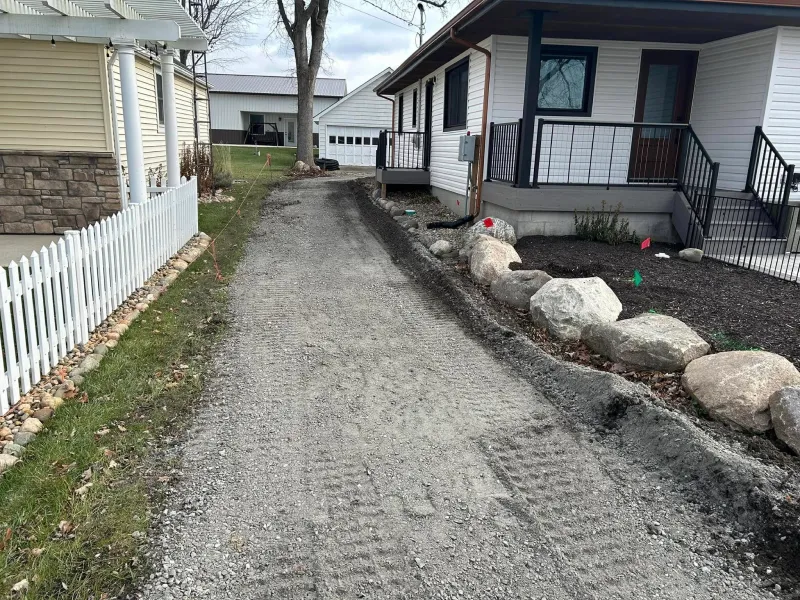
The surface is the last thing to get right. Bumps and dips that seem minor in bare dirt turn into scalped spots and puddles once grass covers them. A good final grade looks plain, which is the point: even, sloped where it should be, and ready for seed or sod when the machine leaves. The hero photo shows that stage beside a new drive, a fresh topsoil bed against the house with survey flags still standing in it. There is more on the whole process on our final yard prep page for Arcadia.
Clean edges along drives, walks and beds
The edges are the part of a yard people notice every day. Where a lawn meets a drive, a walk or a planting bed, the grade should sit right: low enough that water off the hard surface moves into the yard and away, high enough that the mower does not catch a lip.
Builders often leave those edges rough, with gravel spilled into the yard, soil heaped against a walk, or a drop along the side of the drive. Final yard prep cleans them up. Gravel gets pulled back where it belongs, beds get shaped so mulch and plantings sit properly, and the topsoil gets feathered down to meet each hard edge cleanly.
Boulders set in a bed need the same care around them. The ground gets shaped to the stone so water flows past instead of pooling against it.
Finished yards are in the gallery, and the rest of what we do nearby is on the Arcadia page. If your builder just handed you the keys and a yard of dirt, let the owner know what was left behind.
Common questions
Should I seed right after the builder finishes?
Not until the yard has been checked. Seed spread over rough grade grows on whatever is there, including washout, rock and dense clay, and the lawn shows it. A final grade first, with the debris out and topsoil down, gives seed a fair start. The owner can look at the yard and tell you how much work it really needs before anything gets planted.
Can you fix a yard that was already seeded and failed?
Yes. Patchy lawns around a new build usually trace back to something buried or a slope running the wrong way. The thin grass gets stripped where needed, the problem underneath gets dug out or corrected, and the area gets regraded and topsoiled again. It is more work than doing it first, and it fixes the actual cause.
Do you handle the drive and walk edges too?
Yes, that is part of the job. Gravel that spilled into the lawn gets pulled back, soil piled against walks gets cut away, and the grade along every hard surface gets set so water moves off it and the mower rides smoothly over the joint. Clean edges go a long way toward making a new yard look finished.
Want the yard finished as carefully as the house?
Short Excavating does final grading and yard prep around new homes in Arcadia and the rest of Hamilton County, with the owner checking every slope himself.
Call the Owner (260) 216-9073 What It’ll Cost