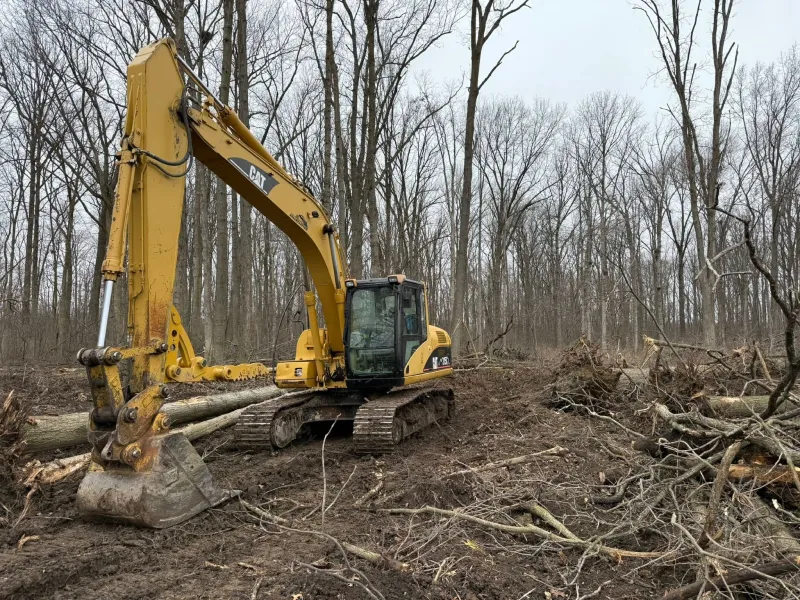
Clear it to the roots once, and build on it for good.
Full clearing around Arcadia for a house, a pole barn, a new field or a yard. Trees come down, stumps and root mats come out, and the site is handed over at rough grade.

Old fencerows come out of the farm ground.
A lot of the clearing around Arcadia happens on ground that has been farmed for generations. Somewhere along the way a fence went up between two fields, the posts rotted, and a row of trees and brush grew up along the wire. Now the fields are one, or the corner is about to become a house lot, and that fencerow is sitting in the middle of it.
Taking one out is real excavator work. The trees come down, the stumps and roots are lifted out, and whatever old wire and posts turn up get pulled along with them. All of it goes into a brush pile on a spot you and the owner agree on, set where it will not be in the way of whatever comes next.
What you are left with is one piece of open ground where there used to be two fields and a tangle between them. A farmer gets a straight run for equipment. A family building out there gets a lot that is actually as big as the survey says.
The order the work goes in.
Locates called in
Utility lines get marked before any stump is pulled. A root ball can wrap a buried line, and nobody knows until it comes up.
Trees down
Timber is dropped away from anything you want protected, and the limbs and brush are worked toward the pile.
Stumps and root mats out
The excavator lifts each stump and drags the root mat up with it, so nothing is left to rot under the next project.
Rough grade, then handed off
Holes filled, ground knocked down to a rough grade, and the site ready for the builder or the next trade.
Roots left under a slab come back to bite.
Wood buried in the ground does not stay wood. A stump cut flush and left under a pad, a garage floor or a driveway decays over the years, and the soil above it drops into the space it leaves behind. Usually the first anybody hears of it is a crack running across the concrete.
That is why clearing for a build takes the whole stump and the root mat with it. The excavator gets under the stump, lifts it, and shakes the dirt loose so the roots come up attached instead of snapping off in the hole. What is left behind is a crater, and on heavy clay that crater gets filled and compacted in layers so it does not become a soft spot of its own.
It is slow, unglamorous work, and it is the first thing a cheap clearing bid trims, because nobody can see it on the day the job wraps up. The owner does it the long way. A settled slab costs far more to fix than a stump costs to pull, and the crew pouring that slab is going to trust the ground they were handed.
Field tile shows up where nobody drew it.
Farm ground in this part of Hamilton County often has drain tile under it, laid years ago to pull water off the fields, and most of it was never mapped. Fencerows and field edges are where it tends to turn up during clearing. Where open ground needs more than tile, with water that has nowhere to go, the answer is a plan for storm water management around Arcadia.
Two ways to open ground, and which one fits.
There are two ways to get brushy ground open, and they leave very different results behind.
Forestry mulching around Arcadia grinds brush and small trees where they stand and leaves the stumps, the roots and a layer of chips on the soil. It is quick and gentle on the ground, and it suits field edges, woodlot margins and anywhere you want to keep the good trees and use the space between them.
Clearing takes it all, trees, stumps, root mats and brush, down to bare dirt. It is the right call for anything with a foundation or a slab, for a driveway, for a yard that will be graded and seeded, and for ground going back into crops.
Plenty of properties use both. A pole barn site might get cleared to dirt while the woods behind it get mulched so the trees stay. Once the ground is open, land management keeps the new edges from creeping back, and when the house is finished, final yard prep turns the builder’s grade into a yard ready for seed. How clearing works in general is covered on our main land clearing page.
Building sites past the edge of Arcadia.
Clearing around Arcadia is country work: a corner of a field becoming a house lot, a woodlot giving up room for a pole barn, a fencerow standing between two pieces of farm ground. Arcadia is in the north end of Hamilton County, on the same heavy clay as the rest of the county, which is why the backfilling matters as much as the pulling. Short Excavating brings its equipment here as part of the roughly 120-mile area it covers from Fort Wayne.
Everything else we do around town is on the Arcadia page, and past clearing jobs are in the gallery.
Before the first tree comes down.
Question not listed? Ask it when he walks the lot.
Do the stumps come out, or just get cut?
They come out. On a clearing job the excavator lifts each stump and pulls the root mat with it, then the hole is filled and compacted. A buried stump slowly decays and the soil on top of it sinks as it goes, which is the last thing you want under a building or a drive.
Who calls in the utility locates?
We do, before any digging starts. Marked lines get worked around carefully, because the roots of a stump can wrap a buried line. Old field tile is never on the locate map, so the owner also watches every hole on former farm ground and repairs any tile that gets disturbed.
What happens to the trees and brush?
Brush, limbs and stumps get worked into piles in a spot you agree on during the walk, out of the way of the next trade. Good logs can be set aside if you want them. What becomes of the piles after that is something to settle with the owner before work starts.
Will the ground be ready to build on?
It will be rough graded, with stump holes filled and compacted, so the builder or the next trade can get to work. Final grade around a finished house is a separate step that comes later, once the building is up and the yard is ready for topsoil and seed.
Should I clear or mulch my property?
If anything is getting built, paved or farmed, clear it, because the roots have to come out. If you want brushy ground opened up and the good trees kept, mulching usually makes more sense. Many lots need some of each, and the owner will mark which is which on the walk.
How do I get a price for clearing my lot?
Call the owner and tell him where the property is, what is growing on it and what you plan to put there. He walks it, checks access for the machines, and gives you a real number before any trees come down. If something changes once the work is underway, you hear it from him first.
Building on ground that is still wooded?
The owner will walk the lot, look at access, and tell you plainly what it takes to clear it.
Look at the Clearing Work First
Lots opened to bare dirt and fencerows pulled, left at rough grade for the next trade. Browse the gallery, then call about yours.