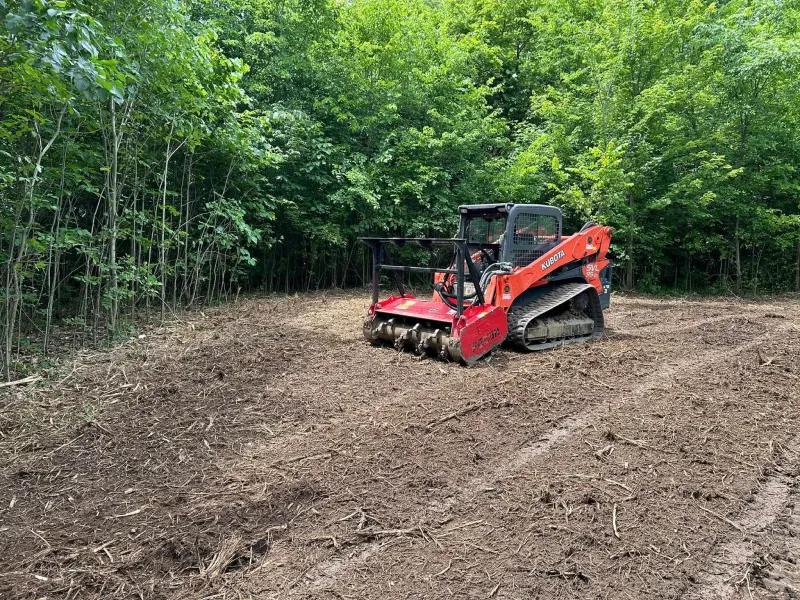
Keep the trees you like, and grind up everything crowding them.
Forestry mulching for overgrown field edges and woodlot margins around Arcadia. Brush and saplings get ground where they stand, and the chips stay put to hold the soil.

Wet spring clay waits its turn.
A track machine with a mulching head on the front is heavy, and the ground around Arcadia is heavy clay. Put the two together in a wet spring week and the tracks sink, tear the sod and leave ruts that hold water long after the brush is gone. Now you have a second problem to pay for.
So the calendar takes orders from the ground. Once a field edge firms up in summer, the machine walks across it and the main thing it leaves behind is mulch. Frozen ground in winter carries the weight just as well, and with the leaves down the owner can pick out every sapling and every keeper from the seat. Late fall goes either way, depending on the rain.
When you call, expect a question about what your ground is doing this week and where it stays soft. If it is soft, you go on the list on the list for when it firms up. A mulching job that waits for dry footing comes out cleaner than one pushed through the mud to hold a date.
Flag the keepers before the head comes down.
Selective work is most of what you are paying for. A field edge that has crept in usually holds a mix: a handful of hardwoods worth saving and a whole lot of saplings, brush and vines filling the gaps around them. Taking everything down would go faster. It would also take out the shade, the windbreak and the reason you liked that corner of the property in the first place.
So the walk comes first. You and the owner go down the edge together and decide what stays. Keepers get flagged. Everything else, the volunteer saplings, the thicket along the old fence, the brush that has swallowed a gate, goes through the mulching head and comes out as chips on the ground.
Working around a tree you are keeping takes patience. The head comes in close without scarring the bark, and the tracks stay off the root flare as much as the ground allows. A rushed operator skips that part, and you find out a season or two later when a tree you meant to save starts dying back from the top.
The man running the mulcher is the owner. When he tells you a tree is staying, he is also the one in the seat making sure of it.
From the first walk to the last pass.
Walk the edge together
You point at what bothers you. He looks at what is growing, how firm the ground is and where a machine can get in.
Keepers marked, number given
Trees that stay get flagged, and you hear what the job will run before anything goes on the schedule.
Ground where it stands
Brush and saplings go through the head and land as mulch right where they grew. No burn pile, no trucks.
Walk it one more time
Before the trailer leaves, the owner goes over the finished edge with you and catches anything he missed.
The chips stay behind, and they earn their spot.
Nothing gets hauled off a mulching job. What used to be brush becomes a layer of shredded wood lying on top of the soil, and that layer keeps working after the machine is back on the trailer. Some brush will still sprout again from the roots, because mulching cuts at or near ground level and leaves the root systems in the soil. Keeping after that regrowth on a schedule is what our land management work around Arcadia is for, so the edge you opened stays open.
Sometimes the mulcher is the wrong machine.
Mulching leaves stumps and roots in the ground. Along a field edge or a woodlot margin that is exactly what you want. Under anything you plan to build on, it is a problem.
If the plan is a house, a pole barn, a driveway or a pad of any kind, roots left in the ground rot over the years and the dirt above them settles with them. That job calls for full land clearing in Arcadia: trees down, stumps and root mats pulled, and the ground left rough graded for whoever builds next. The same goes for turning brushy ground into a field you will work with equipment, where buried stumps catch on everything.
Big timber is the other limit. A mulching head is at its best on brush and smaller trees. Mature hardwoods that have to come down are usually felled and handled as logs.
Plenty of properties end up with a mix, and the owner will tell you which parts of yours need which on the first walk. A cleared pad for the building, a mulched edge around it, and the water off the new ground sent somewhere useful through storm water management. The general rundown on mulching sits on our main forestry mulching page.
Farm edges and woodlots outside Arcadia.
Arcadia sits in the north end of Hamilton County, with farm fields, fencerows and woodlots on every side of town. That is the kind of country where a field edge gives up a little ground to brush every year until a strip of good land is gone. Short Excavating covers Arcadia as part of the roughly 120 miles it works out of Fort Wayne, and the owner walks every property himself before a machine is loaded.
The rest of what we do around town is on the Arcadia page, and you can look through finished work in the gallery first.
Asked on the walk.
Something else? Call the owner and ask him yourself.
Will mulching hurt the trees I want to keep?
Keepers get flagged before the machine starts. The head works in close without scarring bark, and the tracks stay off the root flare as much as the ground allows. The owner runs the mulcher himself, so the person who promised you the tree is the same one working around it.
Do you haul the brush away?
No. Forestry mulching leaves the material where it falls. Brush and saplings are ground into chips where they stand and left as a layer on the soil, where they hold the ground and break down over time. If you want wood piled or removed, that is a clearing job.
When is the best time of year to mulch?
Whenever the ground is firm. Around Arcadia that tends to mean summer once things dry out, or winter after a hard freeze. Wet spring clay lets a track machine rut and tear up the sod, so the owner asks what your ground is doing and schedules around it.
Will the stumps come out?
A mulching head grinds at or near ground level and leaves stumps and roots in place, which helps hold the soil on a field edge. If you are building, putting in a drive or planning to farm that strip, the stumps and root mats need to come out with full clearing.
Will the brush grow back?
Some of it will. Roots left in the soil can send up new shoots, and seed keeps blowing in from the woods. The chip layer slows that down. A pass every so often keeps an opened edge from closing in again, which is exactly what our land management visits are for.
How do I find out what mulching my property will cost?
Call the owner and give him a rough idea of how much ground you have and what is growing on it. He will walk it with you, flag what stays, and give you a real number before anything is scheduled. There is no salesman between you and the man running the machine.
Brush taking over a good piece of ground?
He will walk it, mark the trees worth saving and give you a straight number for the rest.
Brush Gone, Good Trees Still Standing
The gallery shows woodlot edges opened up and field lines cut back. Look over jobs the owner has already done, then call him about your ground.