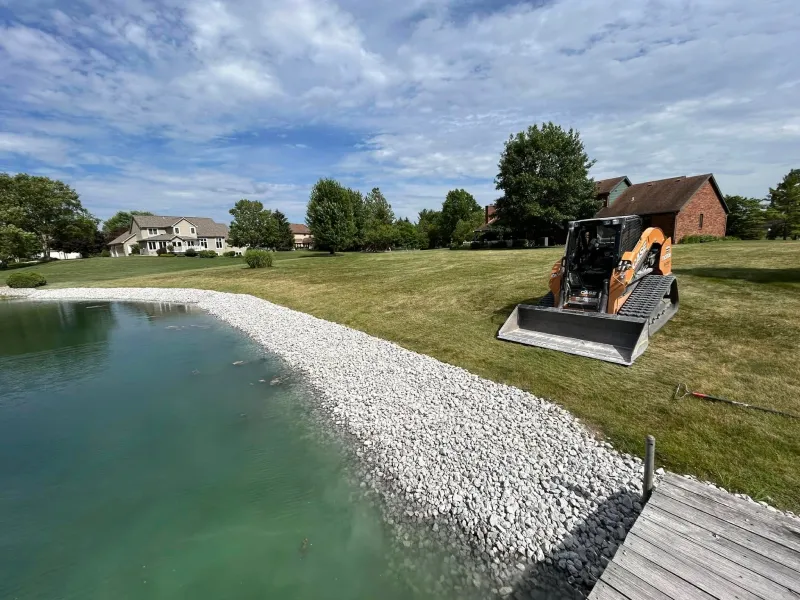
A pond bank washes in from two directions. Waves and rising water chew at the edge, and runoff pours over the top during a hard rain. On heavy clay around Arcadia the bank gets steeper and the pond gets shallower every year that goes by untreated. Stone along the waterline handles the first problem. Bringing the yard’s water to the pond in a controlled way, and letting it out through a properly sized outlet, handles the second.
A pond on a larger lot is one of the best things a property can have, right up until the edge starts sliding in. It happens slowly. The mowed bank turns into a little cliff, grass hangs out over the water, and the shallow end gets a bit muddier every summer. By the time most owners call, they have already lost a strip of yard to the water.
What is eating the edge
Pond banks fail at the waterline first. Wind pushes small waves against the same strip of soil all day, and every time the water rises and falls after a storm, that strip gets soaked and soft and then dries out again. Clay holds together well when it is left alone, but cycle it like that and it slumps off in thin layers.
The result is an undercut. The water carves a notch just below the grass, the turf and topsoil above it hang there for a while, and then a section drops into the pond. Each drop makes the bank steeper and pushes the mowed edge back a little further toward the house.
That soil does not disappear. It settles on the bottom near the edge, which is why ponds with eroding banks tend to grow a muddy, shallow ring where the water used to be deeper. Fixing the bank is partly about saving the yard and partly about keeping the pond from slowly filling itself in.
Why stone along the waterline holds
Rip-rap set along the edge takes the beating the soil was taking. Waves break on rock instead of clay, and rising and falling water moves through the gaps between stones without pulling soil out from behind them.
Doing it right starts with the bank itself. The undercut gets cut back to a stable slope first, because stone dumped against a vertical clay face just slides in along with it. Then the stone goes down along the full length of the edge, from below the normal water level up past where the water reaches during a wet stretch. A finished edge looks like white stone running the whole waterline with lawn coming down to meet it.
Size matters too. Stone that is too small gets nudged around by the water and rolls out into the pond over time. Properly sized stone, laid tight, locks together and stays put, and grass can grow right up to its top edge.
Water coming over the top
The other half of the problem is water running down the bank rather than lapping against it. A big lot sheds a lot of water in a hard rain, and if all of it heads for the pond across the lawn, it cuts small channels down the bank that grow into gullies.
The answer is to collect that water before it reaches the edge and bring it in where it can be controlled. A swale shaped across the lawn can gather sheet flow and steer it to one spot. A yard drain or catch basin can pick up water from a low corner and carry it in solid pipe to the pond, coming out at a point lined with stone so the discharge does not dig a hole in the bank.
On heavy clay this matters even more. Clay soaks up very little, so nearly everything that lands on the yard during a storm runs off somewhere. Choosing that somewhere is most of what storm water management around Arcadia comes down to on a property like this.
An outlet sized for the worst rain
Every pond needs a way for water to leave when it gets too full, and the outlet is where a lot of pond trouble starts. If it is too small or clogged, the water rises over the bank wherever it can, and an overtopping pond can wash out its own edge in a single storm.
So the outlet gets sized for a hard rain, the heavy kind that overwhelms an undersized pipe, instead of an ordinary wet week. That means a pipe or spillway that can carry the extra volume, set at a level that holds the pond where you want it, with stone where the water lands so the discharge point stays put.
It also has to go somewhere it is allowed to go. Water leaving your pond is water arriving on someone else’s ground or in a ditch, and where it ends up gets settled in the plan from the start. The owner looks at where water leaves the whole property before deciding anything about the pond.
Keeping the system serviceable
Ponds collect debris. Leaves blow in, clippings wash in, and the pipes that bring yard water to the pond can catch all of it. A system nobody can get into clogs until the next big storm shows you where.
So the drains get cleanouts where a person can reach them, and inlet points stay visible instead of disappearing under stone. The outlet gets a guard so the pipe does not fill with sticks or turn into a home for animals. Those are the same habits the owner brings to every drainage job: pipe bedded so it does not settle, connections laid out so they can be cleaned, and nothing hidden that will need attention someday.
Once the stone is in and the water has a path, a pond bank mostly takes care of itself. Mowing to the top of the stone and pulling out the odd branch is about all it asks.
If the lawn around the pond needs reshaping after the work, final yard prep is the step that brings it back. Browse the project gallery, see the rest of our work on the Arcadia page, or describe your bank to the owner.
Common questions
Can rip-rap go in while there is water in the pond?
Usually, yes. Most pond edges are done with the water at its normal level, working from the bank with a track machine. If the bank is badly undercut or the water is running unusually high, the owner may suggest waiting for a drier stretch so the slope can be cut back properly and the stone set below the waterline.
Will the stone look out of place in the yard?
Less than people expect. Laid along the full edge it reads as a clean border between lawn and water, and the grass grows right up to it. A ragged, slumping bank looks a lot worse. If you have a dock or a spot where kids get in, the owner plans around those so the edge still suits how you use the pond.
Why not just build the bank back up with dirt?
The same waves and rising water that took the first bank will take the new one, and loose clay pushed into a pond edge is softer than the bank that slumped. Fill can be part of the fix where a lot of edge has been lost, but it needs stone at the waterline to hold it in place over the years.
Is your pond getting wider at the edges?
Owner-operated pond, drain and storm water work for larger lots around Arcadia. He walks the bank, follows the water off the property, and gives you a straight answer.
Call the Owner (260) 216-9073 What It’ll Cost